Virtual Design and Construction Software in the Digital Era
Virtual Design and Construction (VDC) is transforming how buildings are planned and delivered through digital modeling and collaboration. Discover how next-generation text-to-BIM and cloud-based workflows are shaping the future of construction with tensorBIM3D.
ARTICLES
Wiratama
1/26/20262 min read
Virtual Design and Construction Software in the Digital Era
The construction industry is undergoing a significant transformation driven by digital technologies. As projects become more complex and schedules more demanding, traditional design and coordination methods are no longer sufficient to manage the increasing volume of information and interdisciplinary collaboration required. Virtual Design and Construction (VDC) software has emerged as a key approach to support planning, design integration, and construction execution through digital models and data-driven workflows.
Virtual Design and Construction refers to the use of digital representations of buildings and infrastructure to simulate and analyze project outcomes before physical construction begins. By working with virtual models, project teams can evaluate design intent, construction feasibility, and performance aspects in a controlled digital environment. This approach improves coordination between architects, engineers, and contractors, while also reducing uncertainty and minimizing errors that typically appear during later construction stages.
One of the core foundations of VDC is Building Information Modeling (BIM). BIM enables the creation of intelligent 3D models that contain both geometric and non-geometric information, such as materials, quantities, and technical specifications. These models support design coordination, clash detection, and documentation generation. Beyond visualization, BIM-based VDC workflows allow project stakeholders to explore construction sequencing, cost implications, and operational considerations long before construction activities begin.
Recent advancements in software development have expanded VDC capabilities through automation and cloud-based collaboration. Text-to-BIM technology is one such innovation, enabling users to generate building models directly from structured text descriptions. This reduces manual modeling effort and accelerates early design stages. Cloud collaboration further enhances project coordination by allowing multiple users to access, review, and update models in real time from different locations, ensuring that project information remains consistent and up to date.
Another important aspect of modern VDC software is the integration of 3D modeling with ready-to-print 2D drawings and high-quality 3D visualization. Automatically generating drawings from a coordinated 3D model helps maintain consistency between design intent and construction documentation. Detailed 3D rendering also plays a vital role in communicating project concepts to clients and stakeholders, supporting clearer decision-making and reducing misunderstandings related to design interpretation.
By adopting Virtual Design and Construction software, project teams can shift from reactive problem-solving to proactive planning. Design conflicts can be identified earlier, construction strategies can be tested virtually, and project risks can be evaluated before they impact cost and schedule. This digital-first approach contributes to improved efficiency, better communication, and higher overall project quality.
Virtual Design and Construction continues to evolve as part of the broader digital transformation in the construction sector. With the integration of automation, cloud platforms, and intelligent modeling, VDC software is becoming a central tool for modern project delivery. It supports a more collaborative, transparent, and data-driven construction process, helping organizations adapt to the increasing complexity of today’s built environment.
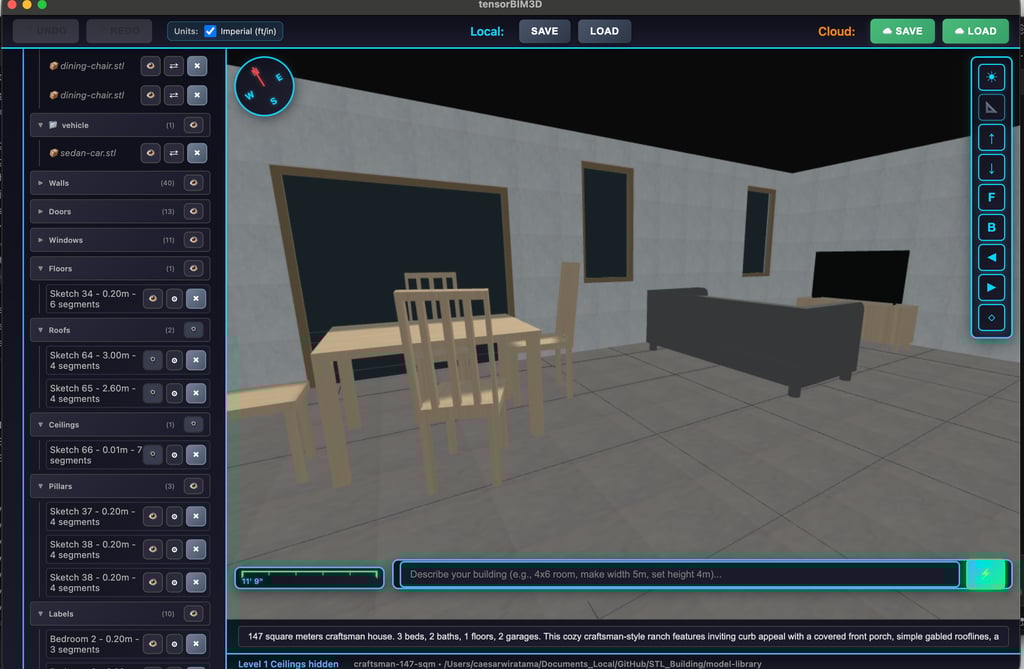
As an example of this evolution, tensorBIM3D is a text-to-BIM software with cloud collaboration capabilities that supports 3D modeling, ready-to-print 2D drawings, and detailed 3D rendering within a unified workflow. By combining automation with collaborative digital modeling, tensorBIM3D represents how next-generation VDC tools can streamline design processes and enhance coordination across project teams.